Customer Centric Product Management for Growth & Loyalty
Learn how customer centric product management drives growth and loyalty. Discover strategies to transform customer insights into market success.

The Evolution of Customer-Centric Product Management
Product management has evolved. It's shifted from an internally driven process, concentrating on features, to a laser focus on the customer. This new model, customer-centric product management, emphasizes truly understanding what customers need and building solutions that directly address those needs. It's more than just surveys; it's about incorporating customer input into every phase of product development. This change is fueled by the understanding that happy customers are key to business growth.
From Features to Feelings: Understanding The Shift
Traditional product management often operated in isolation. Product roadmaps were built on internal guesses and competitive analysis. Customer feedback, if collected at all, was rarely a priority. This inward-looking approach frequently resulted in products that missed the mark, leading to wasted resources and unhappy customers. Customer-centric product management changes this. It puts the customer first, focusing on continuous feedback and iterative development.
The Impact of Customer Centricity: Data Speaks Volumes
To understand the real benefits of a customer-focused approach, let's look at some compelling data:
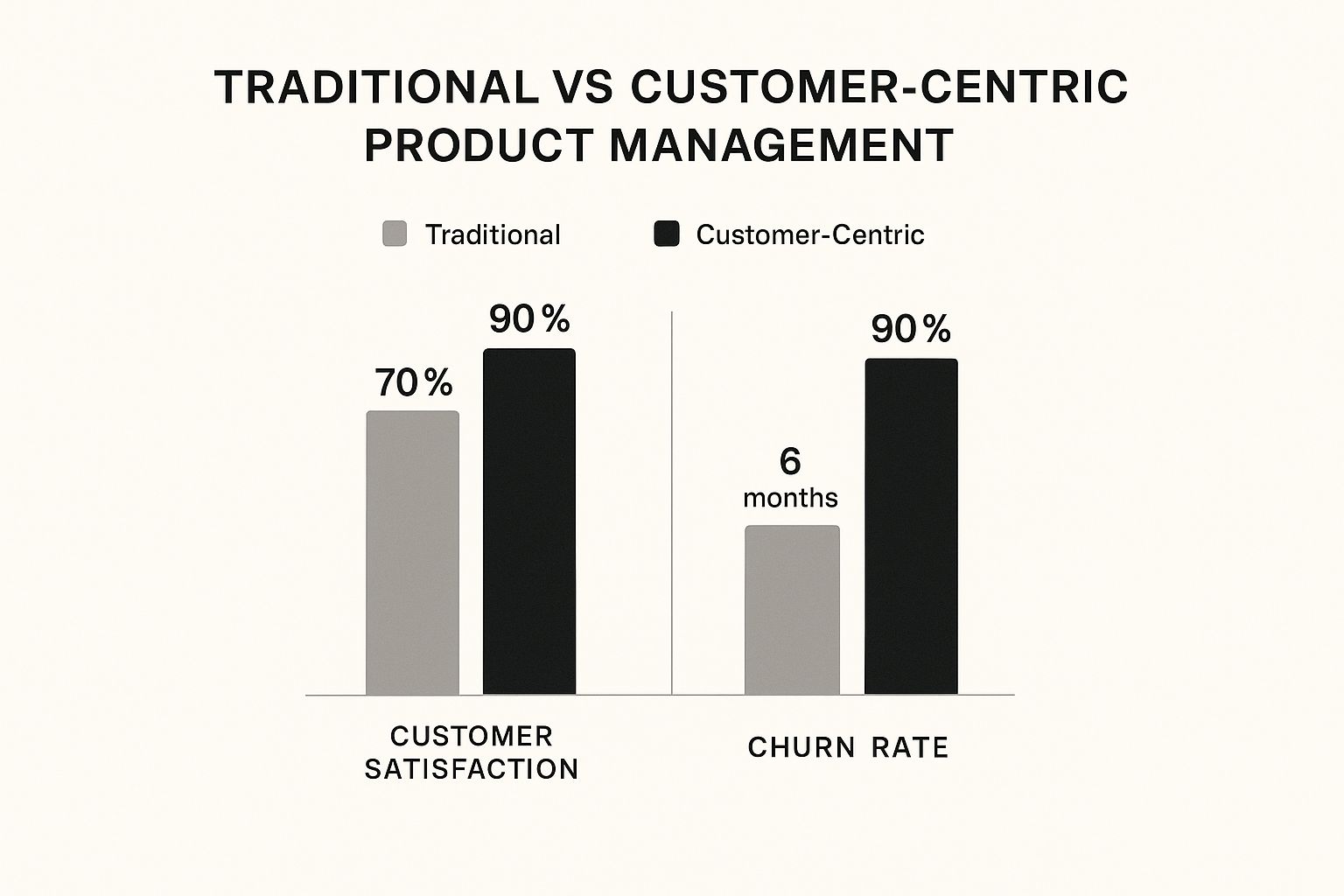
This infographic showcases the significant improvements customer-centric product management delivers. Customer satisfaction increases dramatically, from 70% to 90%. Time-to-market is cut in half, from 6 months to 3 months. And churn rate drops substantially, from 15% to 8%.
This clearly shows that prioritizing the customer leads to improved user happiness, faster product releases, and higher customer retention. Businesses that prioritize customer experience (CX) also see major financial gains. Specifically, organizations emphasizing CX see revenue grow by 80%. Learn more about customer experience statistics. Furthermore, customer-centric companies are reporting 60% higher profits than their competitors. This clear link between focusing on the customer and financial success highlights the importance of a customer-centric approach.
To illustrate the core differences between the two approaches, consider the following comparison:
Traditional vs. Customer-Centric Product Management
This table illustrates the fundamental differences between traditional product management approaches and customer-centric methodologies.
| Aspect | Traditional Approach | Customer-Centric Approach |
|---|---|---|
| Primary Focus | Internal needs and product features | Customer needs and problem-solving |
| Feedback Collection | Limited or infrequent; often an afterthought | Continuous and integrated into the product lifecycle |
| Development Process | Waterfall or siloed development | Agile and iterative development, incorporating feedback |
| Metrics | Product-focused metrics (e.g., features shipped) | Customer-focused metrics (e.g., customer satisfaction, churn rate) |
| Decision Making | Driven by internal assumptions and competitive analysis | Data-driven, based on customer insights and feedback |
Key takeaway: Traditional product management often operates in a silo, prioritizing features. Customer-centric product management, however, prioritizes understanding and addressing customer needs to improve key business metrics.
The Business Case That Wins Executive Buy-In
Customer-centric product management is more than just a popular concept; it's a strategy for sustained growth. It moves beyond simply collecting feedback and delves into truly understanding customer needs, weaving those insights into each stage of the product lifecycle. But how do you persuade leadership to invest in this shift? The key is crafting a strong business case demonstrating the measurable return on investment (ROI) of customer-focused product teams.
Demonstrating the Value of Customer Centricity
Securing executive buy-in hinges on showcasing the direct impact of customer centricity on the bottom line. Focus on the financial advantages that resonate with decision-makers. Customer-centric businesses often see a boost in customer lifetime value, along with decreased churn rates and improved customer acquisition costs. These metrics prove that understanding your customers leads to greater profitability and lasting growth. Furthermore, a customer-focused approach can build resilience during times of market change. By understanding customer needs and adapting swiftly, businesses can weather uncertainty and maintain a competitive advantage. Organizations that postpone this change often lag behind their customer-obsessed rivals, losing market share and struggling to meet evolving expectations. Learn more about developing a customer-led strategy: How to develop a customer-led growth strategy for SaaS companies.
Calculating the True Cost of Poor Customer Experience
Beyond direct financial gains, it's essential to quantify the less obvious costs of not prioritizing the customer. A negative customer experience can generate bad word-of-mouth, diminish customer loyalty, and ultimately, result in revenue loss. Calculating the cost of customer churn, support tickets, and negative reviews reveals the financial repercussions of neglecting the customer. This data provides a powerful rationale for investing in customer-centric projects. Within product management, a customer-centric approach is vital for market leadership. Reports indicate that 86% of global customers will pay more for a great customer experience. This willingness translates into higher revenue and greater customer lifetime value for companies that invest in understanding and improving the customer journey. For further statistics on customer service, see this resource.
Building a Winning Strategy
To construct a compelling business case, concentrate on these crucial points:
Quantifiable Metrics: Use data to clearly illustrate the financial benefits of customer centricity, such as increased revenue, reduced churn, and improved customer lifetime value.
Real-World Examples: Share case studies of companies that have successfully used customer-centric strategies and the positive results they achieved.
Long-Term Vision: Explain the long-term strategic benefits of customer centricity, like larger market share, stronger brand loyalty, and distinct competitive advantages.
Cost of Inaction: Emphasize the financial consequences of not investing in customer centricity, including lost revenue, reduced customer loyalty, and harm to brand reputation.
By presenting a well-structured business case connecting customer centricity to clear business outcomes, you can gain executive buy-in and secure the resources to reshape your product strategy. A customer-focused approach not only boosts customer satisfaction but also drives continuous growth and long-term achievement.

Frameworks That Transform Customer Insights Into Action
Customer-centric product management hinges on transforming customer insights into tangible actions. This means going beyond simply collecting feedback. It requires actively using that feedback to shape product decisions. This shift necessitates the adoption of proven frameworks that effectively translate raw customer data into actionable strategies. Several methodologies can empower product teams to achieve this, each with its own distinct advantages.
Jobs-to-be-Done (JTBD)
The Jobs-to-be-Done (JTBD) framework emphasizes understanding the underlying "job" customers are "hiring" a product to do. It delves deeper than the functional purpose of a product, exploring the emotional and social dimensions that influence customer behavior.
For instance, someone might purchase a high-end coffee maker not solely for its coffee-brewing capabilities. They might also value the overall experience it provides and the social status it represents. JTBD interviews help uncover these deeper motivations, leading to more relevant product development and resonating more deeply with the target audience.
Customer Journey Mapping
Customer journey mapping visually represents every interaction a customer has with a product. This spans from initial awareness to ongoing engagement. This process illuminates pain points, opportunities, and areas for improvement within the customer experience.
Consider mapping the onboarding process of a SaaS product. This exercise can identify friction points that hinder user adoption. By addressing these issues, product teams can enhance user satisfaction and minimize churn. Mapping provides valuable insights into the customer's perspective, informing targeted improvements.
Empathy Mapping
Empathy mapping enables product teams to develop a deeper emotional understanding of their customers. By considering what customers think, feel, see, hear, say, and do, this framework fosters empathy. It provides a more nuanced understanding of customer needs. This is essential for crafting products that truly connect with users.
For example, an empathy map for users struggling with a particular feature can inform design improvements and the creation of targeted support resources. This approach leads to solutions that cater to both the functional and emotional needs of users. You might be interested in: How to get customer feedback for SaaS.
Integrating Frameworks for Maximum Impact
These frameworks are not mutually exclusive. They often complement one another, creating a powerful synergistic effect. Combining JTBD with customer journey mapping offers a comprehensive view of customer needs and their experiences while trying to fulfill those needs. Empathy mapping adds a crucial emotional layer to this analysis.
To illustrate the benefits of integrating these frameworks, let's look at a comparison of their strengths and weaknesses:
The following table provides a comparison of these popular customer-centric product management frameworks.
Customer Centric Product Management Frameworks Comparison: A comparison of popular frameworks and methodologies for implementing customer centric product management
| Framework | Best For | Complexity | Time to Implement | Key Benefits |
|---|---|---|---|---|
| Jobs-to-be-Done (JTBD) | Understanding customer motivations | Moderate | Moderate | Uncovers deep-seated needs, informs product development |
| Customer Journey Mapping | Identifying pain points and opportunities in the customer experience | Moderate | Moderate | Visualizes customer interactions, informs targeted improvements |
| Empathy Mapping | Developing emotional understanding of customers | Low | Low | Fosters empathy, informs design and support |
This table highlights how each framework offers a unique perspective on the customer. By combining these perspectives, product teams gain a more holistic understanding of their users.
By strategically employing these frameworks, product teams can effectively translate raw customer insights into actionable improvements. This leads to products that truly satisfy customer needs and propel business success. This shift goes beyond simply gathering feedback. It involves actively using these insights to develop products that resonate with users on a deeper level, fostering loyalty and achieving sustainable growth.
Turning Customer Data Into Product Decisions That Matter
Customer-centric product management hinges on transforming raw customer data into impactful product decisions. This involves building robust research programs that effectively combine qualitative insights with quantitative data. This balanced approach provides a comprehensive understanding of customer needs and preferences.
Balancing Qualitative and Quantitative Research
Successful product teams recognize the importance of balancing qualitative and quantitative research methods. Qualitative research, like user interviews and focus groups, offers rich, in-depth understanding of why customers behave in certain ways. For example, conducting user interviews can reveal the motivations and unmet needs driving purchasing decisions. Quantitative research, using methods like surveys and A/B testing, provides the breadth of data needed to understand how many customers share similar behaviors. Combining these approaches paints a complete picture of customer needs.
Overcoming Research Challenges
Gathering truly representative data and avoiding research bias presents significant challenges. For example, relying solely on vocal users in a feedback forum might not accurately reflect the needs of the silent majority. Similarly, leading questions in surveys can skew results and invalidate findings. To address these challenges, diversify research methods and ensure participant demographics align with your target audience. Consider blind testing to minimize bias. When launching a product, customer insights are crucial. For effective strategies, explore resources on new product launch strategies.
Integrating Research and AI-Powered Analytics
Leading organizations integrate findings from various research streams to build a cohesive understanding of customer needs. This holistic view ensures product decisions align with overall customer sentiment. Furthermore, these organizations supplement traditional research with AI-powered analytics. This allows them to uncover hidden patterns and correlations that might otherwise be missed. AI can analyze large datasets, identifying subtle trends in customer behavior and preferences. This blend of human insight and AI-driven analysis leads to more accurate and impactful product decisions.

Prioritizing Research and Demonstrating Value
Effective research prioritization is essential. Focus on questions directly impacting key product decisions. Clearly define the desired outcomes for each research project. This focused approach ensures resources are used effectively. Demonstrating the value of your insights is key to securing stakeholder buy-in. Quantify the impact of research findings on key metrics like customer satisfaction and revenue growth. This data-driven approach highlights the importance of customer research in driving business success. By prioritizing research efforts and communicating their impact effectively, product teams can secure ongoing support for customer-centric initiatives.
Building Teams That Live and Breathe Customer Centricity
Customer-centric product management flourishes when it's deeply ingrained in the right organizational structure and culture. It's not enough to just talk about the customer; their needs must be the entire organization's top priority. This requires a significant change in perspective, shifting from relying on internal assumptions to seeking external validation. Building a truly customer-centric team is challenging, but the rewards are well worth the effort.
Hiring for Customer Empathy
Building a customer-centric team begins with hiring people who genuinely empathize with customers. Look for candidates who are naturally curious about user behavior, their motivations, and their pain points. During interviews, assess their ability to listen attentively and ask insightful questions that demonstrate a deep understanding of customer needs. While skills can be taught, genuine empathy is a valuable inherent trait to look for in potential team members.
Training Programs That Foster Customer Focus
While inherent empathy is a great starting point, ongoing training programs are essential for reinforcing customer-centric thinking. These programs should equip team members with practical skills for gathering, analyzing, and interpreting customer feedback. Train employees on techniques like customer journey mapping, empathy mapping, and user interviews. These methods empower team members to collect valuable insights directly from users and translate that feedback into product improvements. Check out our guide on How user feedback can make or break your product.
Incentive Structures That Reward the Right Behaviors
Aligning incentives with customer-centric goals is crucial for long-term success. Reward behaviors that demonstrate a genuine commitment to understanding and addressing customer needs. This could involve recognizing team members who consistently collect and act on customer feedback. It could also mean rewarding product improvements that directly enhance the user experience. By connecting performance evaluations and rewards to customer-centric behaviors, you reinforce the importance of putting user needs first.
Overcoming Barriers to Customer Centricity
Putting customer-centricity into practice often faces obstacles. Departmental silos can hinder cross-functional collaboration, and short-term financial pressures can sometimes overshadow long-term customer-focused strategies. Existing resistance to change within the organization can also slow progress. Overcoming these challenges requires strong leadership and a clear commitment from upper management. Open communication, collaborative workshops, and shared success metrics can help break down silos and promote a unified customer-centric approach.
Cross-Functional Collaboration
True cross-functional collaboration is essential for a complete understanding of the customer. Product, design, engineering, marketing, and customer success teams must work together seamlessly. They need to share insights and focus their efforts on customer needs. Regular meetings, shared dashboards, and collaborative workspaces can facilitate communication and foster a shared vision for customer success. This collaborative environment ensures that everyone is working towards the same customer-centric goals.
Fostering a Culture of Continuous Learning
Finally, creating a culture of continuous learning is essential for maintaining customer centricity. Encourage teams to actively seek customer feedback, try new approaches, and share what they’ve learned. Regularly review customer metrics and use the data to guide continuous improvements. By creating a culture of open communication, feedback, and continuous improvement, you ensure that your team remains adaptable, responsive, and always focused on providing excellent customer experiences. This ongoing focus on learning and improvement will ultimately drive sustainable growth and build customer loyalty.

Measuring Success Beyond Surface-Level Metrics
Customer-centric product management isn't simply about receiving positive feedback. It's about achieving real, measurable business results. This means looking beyond vanity metrics like website visits or social media followers. Instead, focus on key performance indicators (KPIs) that accurately represent the impact of your customer-focused work. This requires a balanced approach, considering both the customer experience and the bottom line.
The Balanced Scorecard of Customer-Centric KPIs
Successful product organizations use a balanced scorecard of KPIs to understand their overall performance. This means tracking metrics across several important areas:
Customer Satisfaction: Gauge customer satisfaction through surveys, Net Promoter Score (NPS), and customer effort score (CES). These metrics give direct insight into how customers view your product and their overall experience.
Retention and Churn: Monitor customer retention rates and churn to understand how well you're keeping customers engaged and coming back for more. A high retention rate and low churn are signs that your customer-centric approach is working. For further insights, check out this article: Learn more in our article about turning satisfied customers into loyal customers.
Customer Lifetime Value (CLTV): CLTV measures the total revenue a customer generates throughout their relationship with your company. Increasing CLTV shows that your focus on customers is driving long-term value.
Business Outcomes: Link customer-centric initiatives to important business outcomes like revenue growth, market share, and profitability. This clearly demonstrates the positive impact of putting the customer first.
Establishing Baselines and Setting Targets
To measure success effectively, establish clear starting points for your chosen KPIs. This creates a benchmark against which you can track your progress. Then, set challenging but realistic targets for improvement. For example, if your current NPS is 40, aim to raise it to 50 within a defined period. This structured approach helps monitor progress and show the effectiveness of your chosen strategies.
Creating Effective Dashboards
Sharing customer insights with different stakeholders is crucial. Build dashboards that visually represent key metrics and trends in a clear and concise way. Adjust these dashboards to the specific needs of each audience. Executives might be interested in the impact on revenue, while product teams need details about customer feedback and how the product is used. Consider effective team-building strategies when developing customer-centric teams. For more details on high-performing teams, see this article: high performing team.
Attributing Business Outcomes and Avoiding Pitfalls
Showing the direct connection between customer-centric activities and business results is key. Use data and analysis to illustrate how improvements in customer satisfaction correlate with higher revenue or lower churn. This reinforces the importance of customer-centric product management. However, avoid common measurement mistakes that can mislead even seasoned teams. Don't depend on only one metric. A balanced scorecard offers a more complete picture of your performance. Also, be mindful of correlation versus causation. Just because two metrics move in the same direction doesn't mean one directly causes the other.
Communicating Metrics Effectively
Communicating metrics clearly to both executives and frontline teams is vital. For executives, highlight the overall impact on business objectives. For frontline teams, provide actionable insights that can inform their daily tasks. This tailored approach ensures everyone understands the value of focusing on the customer and how it contributes to the company's success. By focusing on meaningful metrics, setting clear goals, and communicating effectively, you can demonstrate the real value of customer-centric product management and achieve sustainable business growth.
Streamline your product development and build a truly customer-centric product with Saylo. Centralize user feedback, roadmapping, and update communications in one intuitive hub. Learn more and sign up for Saylo today!